Key Takeaways
- Georgia personal-injury claims from a Roswell Road crash must be filed within two years of the collision under O.C.G.A. § 9-3-33; wrongful-death claims carry the same two-year deadline.
- Georgia is a modified comparative-negligence state under O.C.G.A. § 51-12-33 — recovery is reduced by your share of fault and barred entirely at 50% or more.
- Sandy Springs Municipal Court hears only traffic citations; civil injury suits from this stretch are filed in Fulton County State Court at 185 Central Ave SW, Atlanta, or in Fulton County Superior Court for larger cases.
- Rear-end, left-turn, and lane-change sideswipes account for the bulk of car-on-car crashes between Mystic Drive Northeast and Pill Hill, and each carries a different fault burden.
- Trauma routing from a serious Roswell Road crash typically runs to Northside Hospital (Level III), Children's at Scottish Rite (pediatric Level I), or Emory Saint Joseph's — all within roughly three miles north — with Grady downtown reserved for catastrophic adult cases.
- Knowing which Sandy Springs Police reporting district covers your block, and where APD Zone 2 picks up south of the city line, drives how the crash report and case file are built from day one.
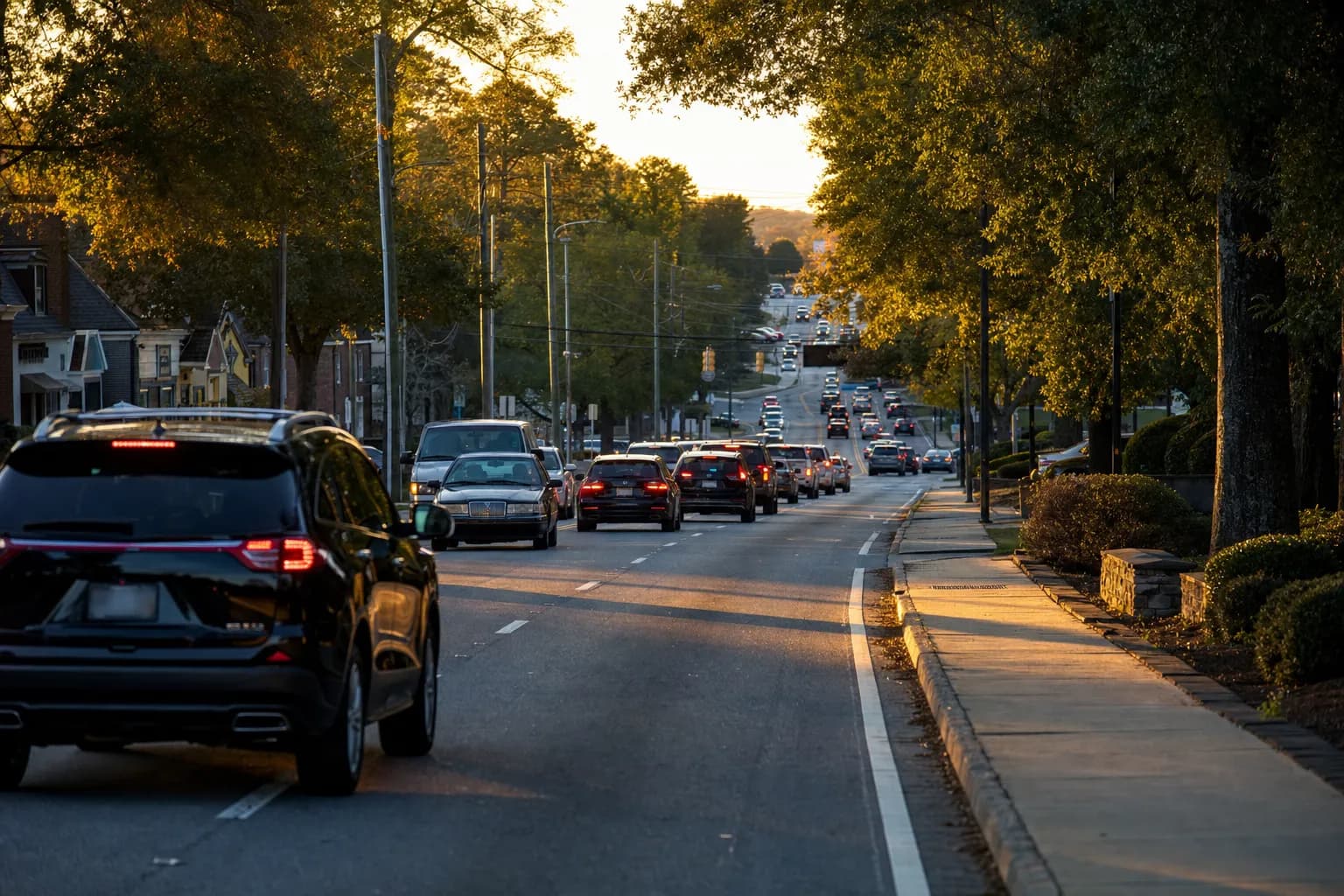
A Sandy Springs Roswell Road car accident lawyer represents drivers and passengers hurt in vehicle-on-vehicle crashes along Roswell Road (US 19 / GA 9) between Mystic Drive Northeast and the Pill Hill medical complex — Northside Hospital, Children's Healthcare of Atlanta at Scottish Rite, and Emory Saint Joseph's. The corridor's stop-and-go traffic, unsignalized blocks, and hospital-bound turning volume produce a predictable set of rear-end, left-turn, and lane-change collisions governed by Georgia's two-year statute of limitations and 50% comparative-fault rule.
Why Roswell Road Produces So Many Driver-vs-Driver Crashes
Roswell Road from Mystic Drive Northeast through Pill Hill was not designed as the regional hospital corridor it has become. It is a four-lane primary arterial carrying US 19 and GA 9 designations at a posted 35 mph, threading curb cuts, on-street parking, and unsignalized blocks through a dense residential stretch between Chastain Park to the south and the medical complex to the north. The lanes are narrow, the shoulders are thin, and the gaps between signals invite drivers to accelerate hard and brake harder — the textbook conditions for rear-ends in stacked patterns.
According to the National Highway Traffic Safety Administration, rear-end collisions are the most common crash type on U.S. roads and account for roughly 29% of all reported crashes nationally. According to the Insurance Institute for Highway Safety, left-turn crashes at intersections without protected left-turn phasing are overrepresented in fatal and serious-injury collisions, with the turning driver at fault in the large majority of cases. Roswell Road through Sandy Springs reproduces both patterns in volume.
Land use compounds the design problem. Northside Hospital alone runs three large shift changes daily at roughly 7 a.m., 3 p.m., and 11 p.m., pushing patient-transport, employee, and visitor volume onto Roswell Road. Fountain Oaks Shopping Center pulls turning traffic across the lanes. MARTA Route 5 buses run the corridor end to end, and bus pull-outs into 35 mph traffic produce lane-change sideswipes with the cars behind them — a corridor-design fact that defines this stretch even though MARTA-vehicle claims sit in a separate legal lane covered in our MARTA bus accident claims guide.
How Roswell Road Car Crashes Break Down
The legal path on Roswell Road depends on the geometry of the crash. A rear-end in stop-and-go traffic between signals turns on following distance and the lead driver's brake lights. A left-turn collision at an unsignalized block turns on the turning driver's duty to yield. A lane-change sideswipe — most often a driver swerving around a MARTA Route 5 pull-out — turns on lane-position evidence and mirror coverage. Mixing those tracks costs claims real money, which is why a Sandy Springs Roswell Road car accident lawyer reads the geometry first and the police report second.
| Crash Type | Typical Roswell Road Geometry | Presumptive At-Fault Party | Governing Statute(s) | Critical Evidence |
|---|---|---|---|---|
| Rear-end in stop-and-go traffic | Between Mystic Drive NE and Wieuca Road; queue building behind signal or turning vehicle | Following driver (presumed) | O.C.G.A. § 40-6-49 (following too closely); § 40-6-180 (basic speed) | EDR data, brake-light photos, signal-timing records, dashcam |
| Left-turn at unsignalized block | Driver crossing oncoming lanes into a side street or strip-center entrance | Turning driver (presumed) | O.C.G.A. § 40-6-71 (vehicle turning left); § 40-6-73 (entering roadway) | Skid marks, point-of-impact damage, witness statements, intersection photos |
| Lane-change sideswipe near MARTA pull-out | Two cars in same direction; one drifts left to pass a stopped bus or curb-lane queue | Lane-changing driver | O.C.G.A. § 40-6-48 (driving on roadways laned for traffic); § 40-6-123 (turning movements / lane changes) | Mirror-coverage analysis, paint-transfer location, surveillance from corridor businesses |
| Stop-and-go pileup (three+ cars) | Multi-car chain behind sudden braking — common during Pill Hill shift-change surges | Multiple parties; allocated by O.C.G.A. § 51-12-33 | O.C.G.A. § 40-6-49; § 51-12-33 | Sequence-of-impact damage diagram, every party's EDR data, scene video |
| Failure-to-yield merging from driveway | Strip-center exit or hospital-feeder cut onto Roswell Road's 35 mph lanes | Entering driver | O.C.G.A. § 40-6-73 (entering roadway from private drive) | Sight-line photos from the driveway, signal-timing context, dashcam |
The rear-end row is the corridor's signature claim — and the one defense adjusters fight hardest to muddy. Georgia's following-too-closely rule under O.C.G.A. § 40-6-49 puts the following driver at presumptive fault, but adjusters routinely argue that the lead driver brake-checked, stopped without cause, or had non-functional brake lights. EDR (event data recorder) downloads from both vehicles, signal-timing records, and surveillance from corridor storefronts generally resolve those disputes — but only if the evidence is preserved fast. Our pillar Georgia car accident lawyer practice handles these statewide; the corridor-specific work happens out of the local Sandy Springs car accident attorneys page.
The left-turn row plays out most often where Roswell Road's signal spacing leaves long unsignalized blocks. A driver pulls left across two lanes of oncoming traffic to reach a side street, a strip-center driveway, or a hospital cut-through, and misjudges the closing speed of an oncoming car. O.C.G.A. § 40-6-71 governs the turning driver's duty to yield. Point-of-impact damage paired with skid-mark measurements usually settles the question.
The lane-change row is where the MARTA Route 5 bus pull-outs show up not as a transit-claim issue but as a car-on-car fact pattern. A driver in the curb lane brakes hard behind a bus that has pulled to the stop; the driver behind swings into the inside lane to get around the stack and clips a car already there. The legal claim is between the two passenger-car drivers — but the corridor-design fact (Route 5's stop frequency) is part of how the case gets framed.
Following-Distance, Stop-and-Go, and the Pill Hill Surge
Mark Wade, lead attorney at Georgia Auto Law, has handled car-on-car cases up and down this stretch and points out that the Pill Hill shift-change surge is when the rear-end claims stack up. Between roughly 6:30 and 7:30 a.m., 2:30 and 3:30 p.m., and 10:30 and 11:30 p.m., Northside, Scottish Rite, and Emory Saint Joseph's collectively push thousands of employees, patients, and visitors onto Roswell Road. Drivers slow for hospital-bound left turns the corridor's signal timing was never designed to absorb, and the following driver pays for the next thirty feet of stopping distance.
The defense playbook in those rear-ends is consistent: argue the lead driver's brake lights were out, argue the lead driver stopped without cause, argue the following driver had no realistic chance to stop. Each argument has a documented answer — bulb-continuity reports from the post-crash inspection, signal-timing logs from Sandy Springs traffic engineering, and EDR data showing the lead driver's speed in the seconds before impact. Mark Wade routinely sends an investigator within 48 hours, because once a damaged vehicle is repaired or scrapped, the EDR data goes with it. The difference between a 0% fault finding for a rear-ended client and a 25% finding is usually the speed of that early documentation.
For drivers whose case will turn on stop-and-go geometry rather than a single dramatic moment, talking to a Sandy Springs rear-end accident lawyer before signing anything is the right next step. Adjusters know Roswell Road's congestion makes rear-end claims look routine — they will offer fast, low numbers in the hope you do not notice the soft-tissue or concussion symptoms emerging over the first two weeks.
Have Questions About Your Case?
Get a free consultation with an experienced Georgia accident attorney.
Trauma Routing from a Serious Roswell Road Crash
The Pill Hill cluster's location is the corridor's one design advantage. A serious car-on-car crash between Mystic Drive Northeast and Wieuca Road sits within roughly three miles of three trauma-capable hospitals, and the routing decision the responding EMS crew makes on scene shapes both clinical outcomes and the medical record that drives the claim.
According to the Centers for Disease Control and Prevention, the first hour after a serious traffic crash — the "golden hour" — is the highest-leverage window for trauma intervention, and access to designated trauma care during that window correlates with substantially lower mortality. Northside Hospital, about 2.7 miles north, operates as a Level III trauma center. Children's Healthcare of Atlanta at Scottish Rite, about 2.5 miles north, is a pediatric Level I trauma center. Emory Saint Joseph's, about 2.9 miles north, handles adult acute care. For catastrophic adult trauma, EMS may route to Grady Memorial Hospital downtown — a Level I adult trauma center about 11 miles south — even though it is farther.
Mark Wade notes that the choice between Pill Hill and Grady is rarely arbitrary and rarely the patient's. EMS makes the call based on injury severity, vital signs on scene, and trauma-system protocols. From a claims perspective, the routing decision is admissible context: a transport to Grady is evidence the crash produced injuries the on-scene clinicians considered life-threatening. The medical record from the receiving hospital — vitals, imaging, surgical notes, follow-up — becomes the spine of the damages case.
For passengers riding in an Uber or Lyft when the crash happened, the trauma routing is the same but the insurance fight is different — that case turns on whether the rideshare driver was on-app and matched with a passenger at the moment of impact, and it sits in our Uber and Lyft rideshare accidents practice.
Comparative Fault: How Adjusters Argue Roswell Road Car Crashes
Under O.C.G.A. § 51-12-33, Georgia is a modified comparative-negligence state with a 50% bar — at 50% fault or more you recover nothing, and below that your recovery is reduced by your percentage share. Defense adjusters lean on a short list of arguments specific to driver-on-driver fact patterns:
- In rear-end claims, adjusters argue the lead driver brake-checked or had inoperative brake lights — answered with bulb-continuity inspection, EDR data, and any dashcam from the following vehicle.
- In left-turn claims, adjusters argue the oncoming driver was speeding — answered with signal-timing records and EDR speed traces.
- In lane-change sideswipes, adjusters argue the struck driver was drifting in their lane — answered with paint-transfer location, mirror-coverage analysis, and corridor surveillance.
- In stop-and-go pileups, adjusters try to allocate fault across multiple drivers to dilute any single carrier's exposure — answered with a sequence-of-impact damage diagram and EDR downloads from every involved vehicle.
Comparative-fault arguments decay if the documentation does not happen fast. A repaired bumper hides paint transfer; a scrapped vehicle takes EDR data with it; signal-timing logs roll off in a few weeks; storefront surveillance overwrites in days. The first call after a serious crash should reach a Sandy Springs Roswell Road car accident lawyer, not the at-fault driver's adjuster.
Fulton County Courts, Sandy Springs Police, and the Right Filing Venue
All of Roswell Road north of the Buckhead boundary sits inside the City of Sandy Springs and Fulton County. Sandy Springs incorporated in 2005, and its municipal court hears only traffic citations — not personal-injury cases. Civil claims are filed in Fulton County State Court at 185 Central Ave SW, Atlanta, or in Fulton County Superior Court for larger or equity cases. Adjusters who suggest you can resolve the injury claim in Sandy Springs Municipal Court are testing you.
South of the Sandy Springs city line into Buckhead, Atlanta Police Department Zone 2 takes over crash investigation; in Sandy Springs proper, Sandy Springs Police Department handles it. Crashes that straddle the boundary occasionally produce duplicate reports. Buckhead injury lawyers handle cases that begin south of the line, while the broader Atlanta personal injury law firm market covers the full Fulton County footprint.
Hit-and-run drivers fleeing a Roswell Road crash — most often after a Chastain Park event — pull the case into a different recovery track that runs through your own uninsured-motorist coverage under O.C.G.A. § 33-7-11. Those facts are covered in our hit-and-run crash claims practice.
What to Do at the Scene of a Roswell Road Car Crash
If you were just in a car-on-car crash on Roswell Road between Mystic Drive Northeast and Pill Hill:
- Call 911 immediately. Concussion symptoms and internal injuries often present hours later, and the dispatch timestamp anchors your medical record.
- Tell the responding officer where the crash occurred so Sandy Springs PD writes the report at the correct address. Get the case number before you leave.
- Photograph both vehicles' damage including paint-transfer marks, the road for 100 feet in each direction, and the position of every other car still on scene.
- Photograph the brake lights of the lead vehicle (and your own) before the cars are moved.
- Note the time precisely — Pill Hill shift-change windows (~7 a.m., ~3 p.m., ~11 p.m.) are admissible context for stop-and-go rear-end claims.
- Collect contact info for every witness, including drivers stopped behind the crash.
- Do not give a recorded statement to the at-fault driver's insurer before talking to a lawyer.
- Seek medical treatment the same day — Northside, Scottish Rite, and Emory Saint Joseph's are all within roughly three miles. Treatment gaps are the second-favorite defense argument after comparative fault.
- Preserve the vehicle until EDR data can be downloaded. A repaired or scrapped car takes the most important evidence with it.
Last reviewed: May 26, 2026
Frequently Asked Questions
How long do I have to file a car accident claim after a Roswell Road crash in Sandy Springs?
Two years from the date of the crash under O.C.G.A. § 9-3-33 for both personal injury and wrongful death. Property-damage-only claims have a four-year deadline under O.C.G.A. § 9-3-32. Those deadlines apply whether the other driver was insured, uninsured, or fled the scene; missing them ends the claim.
What court hears car accident cases from a Roswell Road crash in Sandy Springs?
Civil claims from Roswell Road crashes are filed in Fulton County State Court at 185 Central Ave SW, Atlanta, or in Fulton County Superior Court for larger or equity cases. Sandy Springs Municipal Court is traffic-only and does not hear injury suits — any traffic citation against the at-fault driver is decided there, but the civil claim is a separate proceeding.
I was rear-ended in stop-and-go traffic on Roswell Road. Is the driver behind me automatically at fault?
In Georgia, the following driver carries a presumption of fault under O.C.G.A. § 40-6-49 for following too closely, but the presumption is rebuttable. Adjusters routinely argue the lead driver brake-checked, stopped without cause, or had inoperative brake lights. EDR data from both vehicles, signal-timing records, and corridor surveillance usually settle the question — but the evidence has to be preserved fast, before vehicles get repaired or scrapped.
What if the other driver was turning left across Roswell Road into a side street?
Georgia's left-turn statute under O.C.G.A. § 40-6-71 requires a driver turning left to yield to oncoming traffic close enough to be an immediate hazard. The turning driver is almost always presumptively at fault in left-turn collisions on Roswell Road's unsignalized blocks. Skid marks, point-of-impact damage, and witness statements are the corroborating evidence; the defense will sometimes argue the oncoming driver was speeding, which is answered with signal-timing records and EDR speed traces.
Where will I be treated if I'm seriously hurt in a Roswell Road crash?
Pill Hill sits roughly three miles north. EMS typically routes adult trauma to Northside Hospital (Level III) or Emory Saint Joseph's, pediatric trauma to Children's Healthcare of Atlanta at Scottish Rite (pediatric Level I), and catastrophic adult cases to Grady Memorial Hospital downtown (Level I adult trauma, about 11 miles south). The routing decision is made by the responding EMS crew based on injury severity and trauma-system protocols, and the receiving hospital's medical record becomes the spine of any damages case.
Who pays my hospital bills at Northside, Scottish Rite, or Emory Saint Joseph's while my case is pending?
Bills are usually covered through your health insurance (which will assert a subrogation lien against any settlement), any med-pay coverage on your own auto policy, and — for extensive treatment — letters of protection from treating providers that defer payment until the case resolves. Georgia does not require PIP, so there is no automatic auto-policy medical benefit unless you bought med-pay. An experienced attorney coordinates those sources so collections do not chase you while the claim is pending.
Talk to a Sandy Springs Roswell Road Car Accident Lawyer at Georgia Auto Law
If you or a family member was hurt in a car-on-car crash on Roswell Road between Mystic Drive Northeast and the Pill Hill medical complex, talk to a Sandy Springs Roswell Road car accident lawyer at Georgia Auto Law before you talk to any insurance adjuster. Mark Wade and our team handle rear-end, left-turn, lane-change, and pileup claims on this exact corridor — we know the Sandy Springs Police reporting practices, the APD Zone 2 hand-off south of the city line, the Fulton County State Court filing rules, and the design facts that move comparative-fault numbers down. Consultations are free and we work on a contingency fee — no fee unless we recover for you.