
Key Takeaways
- Georgia's master CMV definition (O.C.G.A. § 40-1-1) sets the threshold at 10,001 lbs GVWR, 8+ passengers for compensation, 15+ passengers without compensation, or placardable hazmat — any one criterion is enough.
- A separate Georgia statute (O.C.G.A. § 40-5-142) sets the CDL threshold at 26,001 lbs GVWR or 16+ passengers — so many heavy pickups (Ford F-350, F-450) are CMVs without requiring a CDL.
- A 15-passenger church van is a CMV for registration and insurance, but a 16-passenger version triggers Class C CDL — the 15-vs-16 passenger trap is the rule most lawyers miss.
- Georgia intrastate carriers must carry $100,000 / $300,000 / $50,000 liability (O.C.G.A. § 40-1-112); interstate carriers must carry $750,000 under 49 CFR § 387.9 — a 7.5× difference depending on the carrier's authority.
- Senate Bill 426 (effective July 1, 2024) limits direct-action lawsuits against motor-carrier insurers; the insurer can now be named in suit only when the carrier is insolvent/bankrupt or personal service can't be effected.
- Per the Georgia Governor's Office of Highway Safety, 12% of all fatal crashes in Georgia in 2023 involved large trucks (GVWR over 10,000 lbs). Multi-vehicle fatal large-truck crashes declined 22% — from 150 in 2019 to 117 in 2023 — but every one of those 117 turned on commercial-vehicle classification.
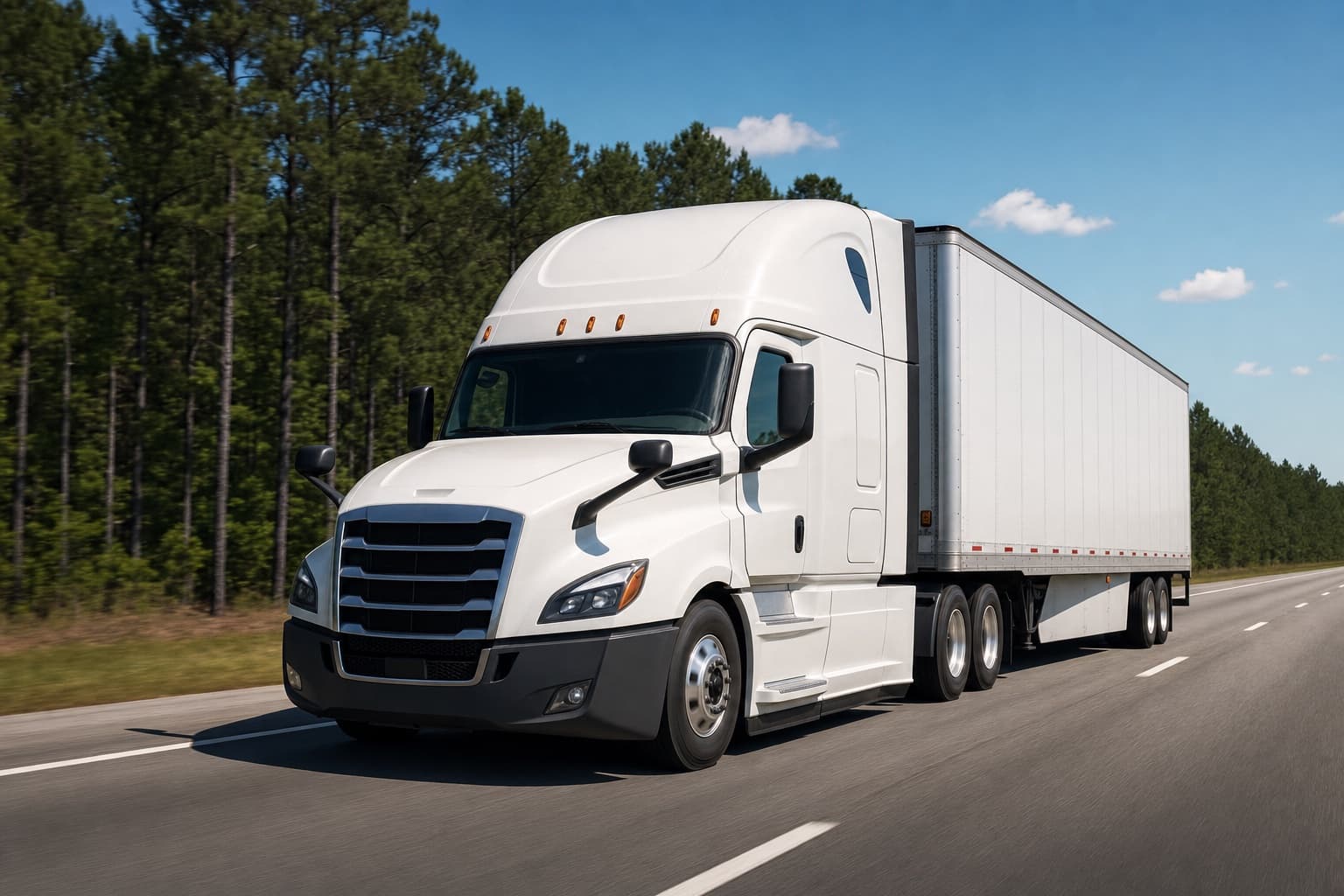
Under Georgia law, a commercial motor vehicle is one that meets any of four federal-mirror thresholds: it has a gross vehicle weight rating of 10,001 pounds or more; it is designed to transport more than 8 passengers (including the driver) for compensation; it is designed to transport more than 15 passengers (including the driver) without compensation; or it transports placardable hazardous materials. That definition lives at O.C.G.A. § 40-1-1 and controls registration, insurance, and Federal Motor Carrier Safety Regulation (FMCSR) coverage for vehicles operated in Georgia.
The answer to "is my vehicle commercial?" depends on which question you are really asking — registration and insurance use one threshold (10,001 lbs), Georgia's Uniform Commercial Driver's License Act uses a different one (O.C.G.A. § 40-5-142, 26,001 lbs / 16+ passengers), and rideshare drivers fall under a third regime entirely (O.C.G.A. § 33-1-24). This guide walks through every threshold a Georgia driver, crash victim, or truck accident attorney needs to know — with the statute behind each one and the practical implications for a Georgia personal injury case.
How Georgia defines a commercial motor vehicle (the four thresholds)
O.C.G.A. § 40-1-1 is the controlling Georgia statute for what counts as a commercial motor vehicle in everyday operation. The statute defines a CMV as:
Any self-propelled or towed motor vehicle used on a highway in intrastate or interstate commerce or both to transport passengers or property when the vehicle:
(A) Has a gross vehicle weight rating, gross combination weight rating, gross vehicle weight, or gross combination weight of 4,536 kg (10,001 lbs.) or more;
(B) Is designed or used to transport more than eight passengers, including the driver, for compensation;
(C) Is designed or used to transport more than 15 passengers, including the driver, and is not used to transport passengers for compensation; or
(D) Is used to transport material determined to be hazardous by the secretary of the United States Department of Transportation under 49 U.S.C. Section 5103 and transported in a quantity that requires placards under regulations prescribed under 49 C.F.R., Subtitle B, Chapter I, Subchapter C.
Three things to notice about this definition. First, the four prongs are disjunctive — meeting any one of them makes the vehicle a CMV. A 27-foot box truck is a CMV under (A); a 12-passenger airport shuttle is a CMV under (B); a church bus designed for 18 passengers is a CMV under (C); a fuel-delivery pickup hauling placardable hazmat is a CMV under (D) even if it weighs less than a Honda Accord.
Second, the rating language matters. Subsection (A) uses gross vehicle weight rating (GVWR) and gross combination weight rating (GCWR), not what the vehicle actually weighs that day. GVWR is the maximum a manufacturer certifies the vehicle to weigh, stamped on the federal label inside the driver's-side door jamb. A pickup that is empty on the highway is still a CMV if its GVWR sticker reads 10,001 lbs or higher.
Third, this definition is Georgia's master CMV definition for insurance, registration, and FMCSR scope — but it is not the CDL definition. CDL licensing has a different, higher threshold (covered next). The same vehicle can be a CMV under § 40-1-1 without requiring a CDL to drive.
When does a vehicle need a CDL in Georgia?
The CDL question is governed by Georgia's Uniform Commercial Driver's License Act, O.C.G.A. § 40-5-142, which defines a commercial motor vehicle for licensing purposes as:
A motor vehicle designed or used to transport passengers or property if the vehicle has a gross vehicle weight rating of 26,001 or more pounds or such lesser rating as determined by federal regulation, or if the vehicle is designed to transport 16 or more passengers, including the driver.
The same statute then carves out exceptions — vehicles that are NOT considered commercial motor vehicles for CDL purposes:
No agricultural vehicle, commercial vehicle operated by military personnel for military purposes, recreational vehicle, or fire-fighting or emergency equipment vehicle shall be considered a commercial motor vehicle.
"Agricultural vehicle" is defined narrowly: a farm vehicle controlled and operated by a farmer (including family members or employees), used to transport agricultural products, farm machinery, or farm supplies to or from the farm, operated within 150 miles of the farm, and not used as a common or contract carrier.
The Georgia Department of Driver Services issues CDLs in three classes (dds.georgia.gov/license-classes):
- Class A — combination vehicles with a GCWR of 26,001+ lbs where the towed unit exceeds 10,000 lbs (tractor-trailers).
- Class B — single vehicles with a GVWR of 26,001+ lbs (straight trucks, large buses, large box trucks); also covers Class C vehicles with appropriate endorsements.
- Class C — vehicles designed to carry 16+ passengers (including driver), or vehicles transporting placardable hazardous materials, that don't meet Class A or B weight thresholds.
The Georgia CDL has additional state designations for intrastate-only drivers (Non-Excepted Intrastate "NA," Excepted Intrastate), and Georgia allows 18-to-20-year-old CDL holders to operate intrastate-only.
The 15-vs-16 passenger trap
Side-by-side, the two Georgia statutes create a passenger-count trap that most CMV explainers miss:
| Statute | Passenger threshold | What it triggers |
|---|---|---|
| § 40-1-1(C) | 15+ passengers (non-compensation) | CMV for registration, insurance, FMCSR scope |
| § 40-5-142 | 16+ passengers | CDL Class C required |
A 15-passenger church or daycare van is a CMV under § 40-1-1 — it triggers commercial registration considerations and falls within Georgia's motor-carrier safety framework — but the driver does not need a CDL because the seat count stays at 15. Add one more seat and the vehicle pulls in CDL licensing as well. Lawyers handling crashes involving 12-to-15-passenger vans need to know that "no CDL required" does not mean "not commercial."
The 10,001-vs-26,001 lb trap
The same disjunction exists on weight. Section 40-1-1 makes a vehicle commercial at 10,001 lbs GVWR for FMCSR and insurance purposes; § 40-5-142 doesn't require a CDL until 26,001 lbs. Many work pickups — Ford F-350, F-450, Chevy Silverado 3500, Ram 3500 — sit in the 10,001–25,000 lb band. They are commercial vehicles when used in commerce, must comply with FMCSR safety rules, and trigger commercial insurance — but the driver does not need a CDL.
Is my vehicle a commercial vehicle? Vehicle-by-vehicle reference
The table below shows typical GVWR ranges for common vehicles and how each lands under the two Georgia thresholds. GVWR varies significantly by year, trim, drivetrain, and cab/bed configuration — the federal label inside the driver's-side door jamb is the legally controlling number for any specific vehicle.
| Vehicle | Typical GVWR | CMV under § 40-1-1 (10,001 lb)? | Requires CDL under § 40-5-142 (26,001 lb)? |
|---|---|---|---|
| Honda Civic / Toyota Camry | ~3,500 lb | No | No |
| Ford F-150 / Chevy Silverado 1500 / Ram 1500 | ~6,000–7,200 lb | No | No |
| Ford F-250 / Silverado 2500 / Ram 2500 | ~9,900–10,000 lb | Borderline — check the door jamb | No |
| Ford F-350 / Silverado 3500 / Ram 3500 | ~11,500–14,000 lb | Yes | No |
| Ford F-450 / Silverado 4500 / Ram 4500 | ~14,000–16,500 lb | Yes | No |
| Ford F-550 / Silverado 5500 / Ram 5500 | ~17,500–19,500 lb | Yes | No |
| Mercedes Sprinter (cargo, GVWR-rated) | ~8,500–11,030 lb | Depends on rating — often yes | No |
| Box truck, 16-foot | ~12,500 lb | Yes | No |
| Box truck / moving truck, 26-foot | ~25,500–26,000 lb | Yes | Often borderline; Class B if 26,001+ |
| Personal U-Haul rental (move-day use) | varies | Usually not — personal, non-commercial use | No |
| 15-passenger van (e.g., Ford Transit 350 HD) | ~9,500 lb | Yes — under § 40-1-1(C) passenger threshold | No |
| 16-passenger van / small church bus | varies | Yes | Yes — Class C |
| School bus | varies | Yes | Yes (Class B or C, with Passenger + School Bus endorsements) |
| Tractor-trailer (typical Class 8) | up to 80,000 lb GCWR | Yes | Yes — Class A |
| Food truck | varies — often 14,000–26,000 lb | Often yes if used in commerce | Depends on GVWR |
The trailer-combination math
O.C.G.A. § 40-1-1(A) lumps together GVWR, GCWR, gross vehicle weight, and gross combination weight. That means a vehicle that is not a CMV on its own can become one as soon as it is hitched to a heavy trailer.
Worked example: a Ford F-250 with a 10,000 lb GVWR is a borderline non-CMV in solo service. Hitched to a 16,000 lb boat trailer, the combination has a 26,000 lb GCWR — pulling the rig into CMV territory under § 40-1-1(A) and into CDL Class A territory under § 40-5-142, because the towed unit exceeds 10,000 lbs and the combined rating is 26,001+. Whether the driver actually loaded weight matches the rating is irrelevant — the rating controls. For more on how heavy SUVs and pickups can wind up in commercial classification, see our piece on whether SUVs are commercial vehicles.
Is Uber, Lyft, DoorDash, or Amazon Flex a commercial vehicle in Georgia?
Rideshare and delivery-app vehicles are not commercial motor vehicles under federal FMCSR or O.C.G.A. § 40-1-1 unless they cross a weight, passenger, or hazmat threshold on their own. A typical Uber sedan or DoorDash hatchback is a personal vehicle. But Georgia regulates transportation network companies (TNCs) under a separate insurance statute, O.C.G.A. § 33-1-24, that ties available coverage to which period of TNC service the driver was in at the time of the crash.
The three-period structure
Period 1 — App off. The driver is not logged into the TNC network. Personal auto insurance applies. The TNC has no statutory coverage obligation.
Period 2 — App on, no ride accepted. The driver is logged into the TNC network but has not accepted a ride request. The TNC (or the driver's policy, if compliant) must provide bodily injury coverage of at least $50,000 per person, $100,000 per accident, and $50,000 property damage.
Period 3 — Ride accepted through ride completion. From the moment the driver accepts a ride request, through pickup, while the passenger is in the vehicle, and until the trip ends in the app, the TNC must provide a minimum of $1,000,000 per occurrence for bodily injury, death, and property damage. The statute also requires uninsured/underinsured motorist coverage at minimum statutory limits.
Why this matters in a Georgia crash
Two practical points trip up almost every rideshare-crash case:
- The driver's personal auto policy almost certainly excludes commercial use. If the driver was in Period 2 or Period 3 at the time of the crash and the TNC denies coverage, the personal carrier will deny too — leaving an apparent coverage gap. The fix is to confirm app-status records (which Uber, Lyft, DoorDash, and Amazon Flex all retain) and bring the TNC's commercial policy into the claim under § 33-1-24.
- Delivery apps follow the same three-period logic for liability. DoorDash, Uber Eats, Grubhub, Instacart, and Amazon Flex each maintain their own commercial liability programs that activate when the driver is on a delivery. The dollar minimums vary by app and contract — but the structural question is always "what period of service was the driver in at impact?"
A passenger or another motorist hit by a rideshare or delivery driver should never accept "the driver's personal insurance is all that's available" without app-status verification. We cover the rideshare-versus-personal-use question in detail in our post on whether Uber is considered commercial use for your car.
Have Questions About Your Case?
Get a free consultation with an experienced Georgia accident attorney.
Hazardous materials trigger CMV status regardless of weight
Subsection (D) of O.C.G.A. § 40-1-1 classifies any vehicle hauling placardable hazardous materials as a commercial motor vehicle, without regard to weight or passenger count. The hazmat list and placard thresholds are set federally under 49 CFR Subtitle B, Chapter I, Subchapter C.
A 7,000 lb pickup hauling enough liquid propane to require a placard is a CMV. A delivery van carrying small consumer quantities of paint thinner is not. The line is the placard threshold, not the chemistry.
Drivers transporting placardable hazmat in Georgia must additionally hold a CDL with a Hazmat (H) endorsement under O.C.G.A. § 40-5-142 (Class C floor) or whatever higher class applies for weight or combination.
Insurance minimums: Georgia intrastate vs federal interstate
The single most-misreported number in Georgia commercial-vehicle content is the insurance minimum. Several local explainers cite "$100,000 / $300,000" as the minimum without specifying that those figures apply only to intrastate operations under Georgia rule — and that interstate carriers are bound by a much higher federal floor.
| Policy type | Minimum coverage | Authority |
|---|---|---|
| Georgia personal auto | $25,000 per person / $50,000 per accident BI; $25,000 property | O.C.G.A. § 33-7-11 |
| Georgia intrastate motor carrier (property) | $100,000 / $300,000 BI; $50,000 property | O.C.G.A. § 40-1-112 + GDOT rule |
| Georgia intrastate passenger carrier (≤12 pax) | $100,000 / $300,000 | O.C.G.A. § 40-1-112 + GDOT rule |
| Georgia intrastate passenger carrier (>12 pax) | $100,000 / $500,000 | O.C.G.A. § 40-1-112 + GDOT rule |
| Interstate motor carrier (general freight) | $750,000 per accident | 49 CFR § 387.9 |
| Interstate motor carrier (oil) | $1,000,000 | 49 CFR § 387.9 |
| Interstate motor carrier (placardable hazmat) | $5,000,000 | 49 CFR § 387.9 |
| TNC / rideshare — Period 2 | $50,000 / $100,000 / $50,000 | O.C.G.A. § 33-1-24 |
| TNC / rideshare — Period 3 | $1,000,000 per occurrence | O.C.G.A. § 33-1-24 |
Two notes that matter in a Georgia crash:
The federal $750,000 floor has not been adjusted since 1980. Adjusted for inflation, that minimum would exceed $2.8 million in 2026 dollars. (For more on how commercial-vehicle insurance interacts with Georgia claims, see our explainer on commercial truck insurance requirements.) As a result, most established interstate carriers voluntarily carry $1 million to $5 million combined-single-limit policies, and a competent demand on a serious truck-crash case probes the full tower of available coverage, not just the federal minimum.
Georgia Senate Bill 426 restricted direct-action against motor-carrier insurers, effective July 1, 2024. Under the amended O.C.G.A. § 40-1-112, a plaintiff can now name the motor carrier's insurer in the suit only when (1) the motor carrier is insolvent or bankrupt or (2) personal service cannot be perfected after reasonable diligence. The change applies to causes of action accruing on or after July 1, 2024. For Georgia trucking-crash victims, the practical effect is that early service strategy and corporate-status investigation are now critical to preserving the direct-action option.
Who regulates commercial vehicles in Georgia?
Authority over commercial vehicles in Georgia is split across four state agencies and two federal layers.
Georgia DPS Commercial Vehicle Enforcement (CVE) — formerly the Motor Carrier Compliance Division (MCCD), renamed effective July 1, 2025 under House Bill 116 — is the Georgia State Lead Agency for the federal Motor Carrier Safety Assistance Program. CVE adopts and enforces the Federal Motor Carrier Safety Regulations through the DPS Transportation Rules, conducts roadside and terminal inspections, and investigates commercial-vehicle crashes.
Georgia Department of Driver Services (DDS) issues CDLs under O.C.G.A. § 40-5-142 and publishes the Georgia CDL Manual.
Georgia Department of Revenue (DOR) Motor Vehicle Division handles commercial vehicle registration, commercial tag fees, and the Georgia portion of the International Registration Plan (IRP) through the Georgia Trucking Portal.
Georgia Department of Transportation (GDOT) handles oversize/overweight permits through the GAPROS system.
The Georgia Motor Carrier Act of 2012 (House Bill 865) transferred regulation of household-goods carriers, passenger carriers, and limousine services from the Georgia Public Service Commission to DPS. As a result, household goods, charter buses, and limos are now licensed and regulated through DPS — not the PSC.
On the federal side, the Federal Motor Carrier Safety Administration (FMCSA) administers USDOT numbers, operating authority, and the FMCSR itself; Georgia DPS CVE enforces those federal rules at the state level for both interstate carriers operating in Georgia and intrastate carriers subject to FMCSR by adoption.
Georgia commercial vehicle registration and tags
The Georgia DOR treats vehicles weighing 10,001 pounds or more as commercial for registration purposes, mirroring the O.C.G.A. § 40-1-1 threshold. Commercial vehicles operating only within Georgia register at the county tag office; vehicles operating in two or more states with a GVWR of 26,001+ lbs register through the International Registration Plan using apportioned plates. Any vehicle with a registered gross weight of 55,000+ lbs must additionally file IRS Form 2290 (Heavy Highway Vehicle Use Tax).
Annual commercial license-fee tiers under O.C.G.A. § 40-2-151 are GVWR-based, climbing from a modest figure for vehicles under 18,000 lbs to over $700 for the heaviest categories. (Specific dollar amounts are revised periodically by the legislature — current figures are at the DOR site.)
GDOT size and weight limits
Georgia's legal-maximum dimensions and weight for commercial vehicles align with federal limits under 49 CFR Part 658:
- Width: 8'6"
- Height: 13'6"
- Length: 100 feet (including overhang)
- Gross weight: 80,000 lbs
- Single axle: 20,340 lbs
- Tandem axles: 34,000 lbs
Anything beyond these requires an oversize or overweight permit through GDOT's GAPROS system. Single-trip permits cover loads up to 150,000 lbs at modest cost; "superload" permits cover loads above 180,000 lbs at higher cost. Annual permits are available for repeat loads within defined dimensional caps.
Crashes involving permitted oversize or overweight loads are worth special attention: the permit conditions often dictate route, escort, time-of-day, and weather restrictions, and a permit violation is potentially evidence of negligence under Georgia law.
Why CMV classification matters for crash victims in Georgia
When a Georgia crash involves a commercial motor vehicle, the legal landscape changes in five concrete ways:
- Available insurance multiplies. A personal-auto-only crash caps recovery at Georgia's $25,000 personal minimum (often higher in voluntary coverage). A CMV crash unlocks the intrastate $100k/$300k floor, the interstate $750,000+ federal floor, and — frequently — the $1M–$5M voluntary coverage carriers actually buy.
- The carrier becomes a defendant. Under Georgia respondeat superior law, the trucking company is liable for the driver's on-duty negligence. The carrier also has independent duties — negligent hiring, training, supervision, dispatching, and maintenance — that create direct claims even where the driver's individual conduct was reasonable.
- Unique evidence becomes discoverable. Federal Motor Carrier Safety Regulations require commercial carriers to maintain driver logs, hours-of-service records, electronic logging device (ELD) data, drug and alcohol test results, post-crash inspection reports, and driver-qualification files. These records have short retention periods and must be preserved by formal demand within days of the crash.
- The 2024 direct-action restriction shapes service strategy. Under amended O.C.G.A. § 40-1-112, naming the motor-carrier insurer in suit now requires either carrier insolvency or failed personal service. Early diligence in serving the carrier — and in investigating its corporate health — preserves direct-action options.
- The statute of limitations runs at two years. O.C.G.A. § 9-3-33 gives a Georgia personal-injury plaintiff two years from the date of the crash to file. The clock does not pause while a victim is investigating whether the other vehicle was a CMV — and missing the CMV classification analysis at intake can mean missing the deadlines that preserve ELD data and other regulated records. For a step-by-step guide, see our post on what to do if you've been hit by a commercial motor vehicle, or contact a Georgia wrongful death lawyer for catastrophic-injury cases.
The Georgia Governor's Office of Highway Safety reported that large trucks (GVWR over 10,000 lbs, both commercial and non-commercial) were involved in 12% of all fatal crashes in Georgia in 2023 — 172 of 1,491 total fatal crashes. The same report shows multi-vehicle fatal large-truck crashes have declined 22% from 150 in 2019 to 117 in 2023 — a positive trend that is consistent with federal motor-carrier-safety enforcement working as designed.
Practice Pointer
Investigate the GVWR of every vehicle in a crash case. Missing a commercial classification in the first week can turn a $25,000 policy-limits case into one with $750,000 of FMCSA-mandated coverage — and the records that prove the classification have retention periods measured in days, not years.
— Mark Wade, Founding Attorney, Georgia Auto Law
Frequently Asked Questions
What weight makes a vehicle a commercial vehicle in Georgia?
A vehicle is a commercial motor vehicle under O.C.G.A. § 40-1-1 when its gross vehicle weight rating, gross combination weight rating, or actual weight reaches 10,001 pounds. A higher threshold of 26,001 pounds applies under O.C.G.A. § 40-5-142 only for CDL licensing — the FMCSR-scope and insurance threshold is the lower 10,001 lb figure.
Is a pickup truck a commercial vehicle in Georgia?
A standard half-ton pickup (Ford F-150, Silverado 1500, Ram 1500) has a GVWR around 6,000–7,200 lbs and is not a CMV. Three-quarter-ton and one-ton pickups (F-250, F-350, Silverado 2500/3500, Ram 2500/3500) carry GVWRs from about 9,900 lbs to 14,000+ lbs — and any with a GVWR of 10,001 lbs or higher used in commerce is a CMV under O.C.G.A. § 40-1-1, even though no CDL is required until 26,001 lbs.
Is an F-250 a commercial vehicle?
Most Ford F-250 trims sit at the edge — typical GVWRs are 9,900–10,000 lbs. Many F-250s are commercial under § 40-1-1 when used in commerce; many are not. The federal label inside the driver's-side door jamb has the controlling GVWR for the specific truck. If that number is 10,001 or higher, it is a CMV regardless of what it is actually hauling.
Is an F-350, F-450, or F-550 a commercial vehicle?
Yes — when used in commerce. Ford F-350s carry typical GVWRs of 11,500–14,000 lbs, F-450s 14,000–16,500 lbs, F-550s 17,500–19,500 lbs. All comfortably exceed the O.C.G.A. § 40-1-1 10,001 lb threshold. None require a CDL until 26,001 lbs, so these are common examples of "CMV without CDL."
Is a 15-passenger van a commercial vehicle in Georgia?
Yes, under O.C.G.A. § 40-1-1(C) — but only just. The statute treats a vehicle "designed or used to transport more than 15 passengers" without compensation as a CMV. A 15-passenger Ford Transit configured to carry 15 sits at the threshold; configured for 16, it pulls in CDL Class C under § 40-5-142 as well. A church or daycare with 15-passenger vans operates CMVs without the drivers needing CDLs.
Is a U-Haul or rental moving truck a commercial vehicle?
Generally no, for a personal household move. The vehicle is a CMV in the abstract (most 26-foot U-Haul or Penske trucks are at the 26,000 lb GVWR mark), but personal, non-commercial moving use does not trigger FMCSR coverage. A construction company using the same vehicle to haul tools and materials is using it commercially and would be subject to commercial classification.
Is Uber a commercial vehicle in Georgia?
A typical UberX or Lyft sedan is not a commercial motor vehicle under O.C.G.A. § 40-1-1 — the vehicle does not meet any weight, passenger, or hazmat threshold. Georgia regulates rideshare separately under O.C.G.A. § 33-1-24, which requires the TNC to carry $50k/$100k/$50k while the driver is app-on without a ride and $1,000,000 per occurrence once the driver accepts a ride through completion.
Is DoorDash, Uber Eats, or Amazon Flex a commercial vehicle?
The vehicle itself is generally a personal vehicle and not a CMV. But the liability framework mirrors rideshare — DoorDash, Uber Eats, Amazon Flex, Grubhub, and Instacart all maintain commercial liability programs that activate when the driver is on a delivery, and the driver's personal auto policy almost certainly excludes commercial use. After a crash, app-status verification is the key step.
Do I need a CDL to drive a box truck in Georgia?
You need a CDL when the box truck's GVWR is 26,001 lbs or higher under O.C.G.A. § 40-5-142. Most 16- to 24-foot box trucks rate below 26,000 lbs — drivable on a regular Class C Georgia driver's license. A standard 26-foot box truck is right at the line; some configurations are below the CDL threshold, some are above.
What's the difference between O.C.G.A. § 40-1-1 and § 40-5-142?
§ 40-1-1 is Georgia's master commercial motor vehicle definition for registration, insurance, and FMCSR-scope purposes — threshold is 10,001 lbs GVWR, 8+ passengers for compensation, 15+ passengers without compensation, or placardable hazmat. § 40-5-142 is Georgia's CDL-specific definition — threshold is 26,001 lbs GVWR or 16+ passengers, with explicit exclusions for agricultural, military, recreational, and fire/emergency vehicles.
How much insurance must a Georgia commercial vehicle carry?
It depends on whether the carrier operates intrastate or interstate. Intrastate property carriers must carry $100,000 / $300,000 bodily injury and $50,000 property damage under O.C.G.A. § 40-1-112 and the GDOT rule it authorizes. Interstate carriers of general freight must carry $750,000 per accident under 49 CFR § 387.9. Hazardous-materials interstate carriers must carry $5,000,000. Many carriers buy significantly above these floors.
Does Georgia require $750,000 in commercial vehicle insurance?
Not for purely intrastate operations — Georgia's intrastate floor is $100,000 / $300,000 / $50,000. The $750,000 figure is the federal minimum under 49 CFR § 387.9 for interstate carriers of general freight. Carriers operating intrastate routes are bound only by the lower Georgia floor unless they hold federal operating authority.
Are farm vehicles considered commercial in Georgia?
Not for CDL purposes — O.C.G.A. § 40-5-142 carves out "agricultural vehicles" from the CDL definition. The exclusion is narrow: the vehicle must be operated by the farmer (or family/employees), used to transport agricultural products, machinery, or supplies to or from the farm, kept within 150 miles of the farm, and not used as a common or contract carrier. A farm-operated semi-truck on a Georgia interstate hauling produce to Atlanta falls within the exemption; the same truck hauled by a third-party carrier does not.
Are RVs commercial vehicles?
Recreational vehicles are explicitly excluded from the CDL definition under O.C.G.A. § 40-5-142, regardless of weight. A 30,000 lb Class A motorhome used for personal travel does not require a CDL. The exclusion is for personal use only — operating the same RV commercially (for hire) loses the exemption.
Why does CMV classification matter if I'm hit by one?
Classification can multiply available insurance from $25,000 to $750,000+ and unlock independent claims against the carrier for negligent hiring, training, supervision, dispatching, and maintenance. It also opens discovery of ELD data, driver-qualification files, hours-of-service logs, and post-crash drug/alcohol test results that don't exist in a private-vehicle case. Most of those records have short federal retention periods — missing the classification analysis in the first week of the case can mean missing the evidence that proves how the crash happened.